
Nose Hump Reduction in Rajkot
Nose Hump Reduction for a Smoother, More Balanced Nasal Profile
Nose hump reduction may be considered when a visible bump or bridge irregularity affects the side profile. Planning examines whether the prominence involves bone, cartilage or both, while also considering bridge height, tip position, nasal support and the complete facial profile.
- Bone and cartilage components assessed separately
- Tip-to-bridge relationship reviewed
- Expected change and limitations explained clearly
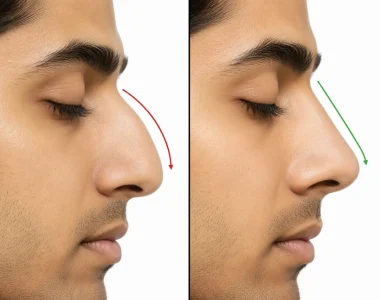
Understanding a Nasal Hump
What Is Nose Hump Reduction?
A nasal hump is a visible prominence along the bridge of the nose. It may be formed by nasal bone, cartilage or a combination of both. Some humps are present from birth, while others become more noticeable during facial growth or after an injury.
Hump reduction is planned as part of rhinoplasty. The surgeon assesses how much correction may improve the profile while maintaining bridge support, nasal function and a natural relationship with the tip.
Interactive Hump Concern Guide
Which Bridge Concern Is Closest to Yours?
Select the closest description to understand what may be reviewed during consultation.
Focused bridge prominence
Visible Dorsal Hump
A clear bump may involve the bony upper bridge, the cartilaginous middle bridge or both.
Overall bridge prominence
High Nasal Bridge
A high bridge may appear prominent over a longer section rather than as one isolated bump.
Contour irregularity
Uneven Bridge Contour
The bridge may look irregular because of bone shape, cartilage, previous injury or earlier surgery.
Trauma-related bridge change
Post-Injury Nasal Hump
An injury may alter the nasal bones, cartilage, septum or alignment in addition to creating a visible prominence.

The Complete Profile Matters
Why Hump Reduction Is Not Only About Removing a Bump
A nasal hump can look more or less prominent depending on the forehead, tip, lips and chin. Reducing the hump without considering those relationships may leave the nose looking too flat or the tip appearing too prominent.
Planning therefore considers the full profile rather than one isolated bridge point. The objective is a smoother and more proportionate contour that still looks natural for the individual face.
A balanced profile is created by relationships between features, not by applying one standard bridge shape to every patient.
Interactive Profile Balance Tool
See How Bridge, Tip and Chin Balance Affect the Profile
Move one simple control at a time. The explanation changes immediately.
Bridge prominence, tip projection and chin balance currently receive similar attention.
Possible Treatment Components
What May Be Included in Nose Hump Reduction?
The exact plan depends on hump composition, bridge support, tip position, breathing and the complete nasal shape.
Bone Reduction
Bony prominence may be reduced or reshaped where it forms the upper part of the hump.
Cartilage Reduction
Cartilage may be adjusted where the middle bridge contributes to the prominence.
Bridge Smoothing
Irregular contour may require controlled smoothing rather than one isolated reduction.
Tip or Support Adjustment
The tip or bridge support may need attention to maintain balanced profile relationships.
Understanding Early Healing
Why the Bridge Can Look Different During Recovery
Swelling, splints and temporary tissue changes can affect how the bridge looks during the early recovery period. Small irregularities or differences in contour may change as swelling settles.
The final profile should not be judged immediately. Healing varies with the procedure, skin, tissue response and individual recovery.
- Early swelling can alter bridge contour
- The profile changes gradually
- Follow-up is part of assessment
- Final refinement takes time

Nose Hump Reduction Cost Estimator
Build an Indicative Treatment Budget
Choose the likely treatment scope and complexity. This is a planning guide, not a clinic quotation.
Consultation and Planning
How Nose Hump Reduction Is Planned
- 01
Define the Main Profile Concern
Discuss hump prominence, bridge height, irregularity, injury history and preferred degree of change.
- 02
Assess Bone, Cartilage and Support
Examine hump composition, bridge width, tip position, septum, breathing and structural stability.
- 03
Plan the Complete Profile
Decide whether focused reduction or combined bridge, tip or structural correction may be appropriate.
- 04
Review Recovery, Limits and Cost
Discuss expected contour, possible risks, healing, postoperative care and a personalised quotation.
Nose Hump Reduction FAQs
Questions Before Bridge Correction
General information about suitability, breathing, recovery and cost.
Ask a QuestionCan a nasal hump be reduced?
Rhinoplasty may reduce a hump where appropriate. The achievable contour depends on bone, cartilage, bridge support, tip position and healing.
Is a nasal hump made from bone or cartilage?
It may involve bone, cartilage or both. Examination helps determine the composition and treatment scope.
Can hump reduction be performed without tip surgery?
Sometimes treatment may focus mainly on the bridge. However, the tip-to-bridge relationship must still be reviewed for profile balance.
Can hump reduction affect breathing?
Bridge reduction changes nasal structure, so support and airway considerations should be included in planning.
How much does nose hump reduction cost in Rajkot?
A broad planning range may begin around ₹65,000 and extend beyond ₹1,50,000 for combined, trauma-related or structurally complex treatment. The clinic’s fee requires assessment.
How long does recovery take?
Early swelling and bruising usually improve over the first weeks, while contour refinement can continue for months.
Will the bridge be completely straight?
The aim is usually a smoother, proportionate profile. Perfect geometric straightness or symmetry cannot be guaranteed.
Take the Next Step
Understand What Degree of Hump Reduction May Suit Your Profile
Book a consultation with Dr. Manali Kakadia to discuss bridge contour, profile balance, breathing, recovery and a personalised cost estimate.