
Rhinoplasty Surgeon
Reconstructive Rhinoplasty
Reconstructive rhinoplasty is considered when the nasal framework itself has been damaged, weakened, displaced or incompletely formed — because of trauma, a congenital difference, tissue loss, disease, or a previous operation that left the structure unstable. Dr. Manali Kakadia approaches these cases by first establishing whether the nose can physically support the change being requested, since restoring structure and protecting the airway often has to come before any visible refinement is even possible.
Patients considering reconstructive rhinoplasty can consult an ENT surgeon in Rajkot for an assessment of nasal structure, breathing function, and the extent of reconstruction required.
- Structural loss, deformity and tissue quality assessed individually
- Support, symmetry and nasal breathing considered as one connected system
- Reconstruction goals, staging and limitations discussed honestly
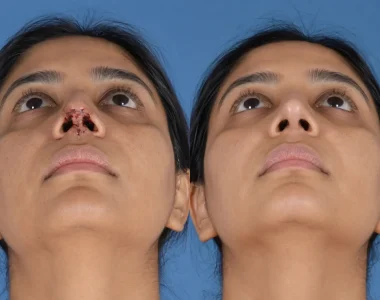
Restoring Form and Function
Rebuilding Nasal Structure After Trauma, Loss or Congenital Difference
A nose that has been broken, operated on more than once, affected by tissue loss, or shaped differently from birth doesn't always have enough of its own cartilage and bone left to simply reshape. In these situations, treatment planning has to start with a more basic question: is there enough structural material to work with, and if not, where can it come from?
This is what separates reconstruction from more straightforward rhinoplasty treatment . A standard reshaping procedure generally works with an intact framework. Reconstructive planning often works with a framework that is incomplete, displaced or scarred, and treats rebuilding that framework as the first job — appearance and breathing are addressed once there is something stable to build on.
The American Society of Plastic Surgeons' overview of the rhinoplasty procedure describes how cartilage from the septum, ear or rib can be used as graft material when a patient's own nasal cartilage isn't sufficient — exactly the kind of graft planning that reconstructive cases frequently require.
This is what separates reconstruction from more straightforward cosmetic rhinoplasty . A standard reshaping procedure generally works with an intact framework. Reconstructive planning often works with a framework that is incomplete, displaced or scarred, and treats rebuilding that framework as the first job — appearance and breathing are addressed once there is something stable to build on.
Treatment Information
Reconstructive Rhinoplasty Treatment Details
| Condition / Concern | Damaged, deficient or displaced nasal structure from trauma, congenital difference, tissue loss or previous surgery |
|---|---|
| Procedure | Reconstructive Rhinoplasty |
| Typical Procedure Time | Approximately 2 to 5 hours, depending on complexity; sometimes staged across more than one operation |
| Performed By | Qualified rhinoplasty and ENT surgeon |
Understanding Nasal Reconstruction
What Is Reconstructive Rhinoplasty?
Reconstructive rhinoplasty is nasal surgery focused on restoring structures that are absent, damaged, weakened, displaced or scarred. It may be considered after significant nasal trauma, a congenital deformity, previous rhinoplasty or septorhinoplasty, infection, tissue loss, or collapse of the nasal framework from any cause. Unlike more straightforward cosmetic reshaping, it usually starts by evaluating the integrity of what's underneath the skin — the bony vault, the septum, the middle vault, the upper and lower cartilages, the nasal valves and the tip-support mechanisms — before deciding what can be repositioned, reinforced or rebuilt outright.
General patient information from Mayo Clinic on rhinoplasty notes that surgery to reshape the nose can also correct impaired breathing caused by structural defects — a point that applies especially to reconstructive cases, where the original defect is often functional as much as it is visible.
There is no single standard reconstructive operation. The plan depends on the original cause of the deformity, any earlier procedures, remaining septal support, scar tissue, skin and soft-tissue quality, nasal-valve function, available graft material and what the patient hopes to achieve — functionally, aesthetically, or both.
Patients looking for reconstructive rhinoplasty in Rajkot can undergo a detailed assessment to understand the structural changes required and the most appropriate treatment approach.
Explore Common Reconstructive Situations
Reconstructive Rhinoplasty: Which Situation Best Describes You?
Reconstructive consultations tend to fall into a handful of recognisable patterns. See which one is closest to your own situation.
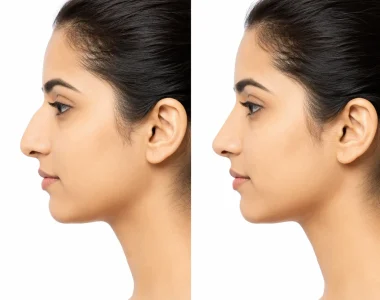
Post-Traumatic Deformity
Reconstructive Rhinoplasty After Nasal Trauma
A significant fracture or soft-tissue injury can leave the nasal bones, septum, cartilage or valve area displaced, narrowed or structurally unstable — often causing a visible deformity and persistent obstruction at the same time. Where the septum is the dominant issue, a more limited deviated septum treatment may be enough on its own.
- History of significant nasal fracture or facial injury
- Visible external deformity following the trauma
- Breathing difficulty that began or worsened after the injury
- Structural displacement confirmed on examination
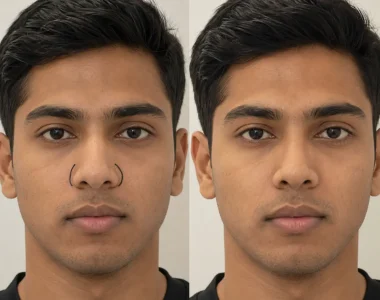
Congenital Nasal Difference
Reconstructive Rhinoplasty for Congenital Nasal Differences
Some patients are born with nasal cartilage, septal alignment or skeletal proportions that developed differently, affecting shape, symmetry or airway function from an early age. Treatment here is highly individual, shaped by anatomy, age, symptoms and what the patient wants to achieve rather than a fixed technique.
- Nasal shape or asymmetry present since birth
- Septal or cartilage development that differs from typical anatomy
- Breathing difficulty linked to the underlying structure
- No history of injury explaining the current shape

Loss of Support After Prior Surgery
Reconstructive Rhinoplasty After Previous Nasal Surgery
An earlier rhinoplasty or septorhinoplasty can occasionally leave inadequate structural support, contour irregularity, valve weakness or persistent breathing difficulty — usually because more cartilage was removed than the framework could safely lose. This pattern often calls for a closer look at revision rhinoplasty alongside reconstructive grafting, rather than a further reduction procedure.
- One or more previous nasal operations
- Visible collapse, pinching or contour irregularity since that surgery
- Breathing that worsened rather than improved afterward
- Known removal of significant cartilage during earlier treatment
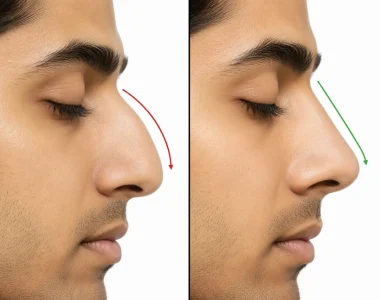
Tissue Loss or Disease-Related Damage
Reconstructive Rhinoplasty for Tissue Loss and Structural Damage
Infection, tumour treatment, skin loss or other disease processes can damage the nasal framework in ways that go beyond what cartilage repositioning alone can fix. These more complex defects often call for cartilage grafts, local tissue reconstruction, or a staged surgical plan carried out over more than one operation.
- Skin or structural tissue loss from infection or disease
- Previous treatment for a nasal or sinus tumour
- Significant loss of native cartilage or bone
- Likely need for staged, multi-step reconstruction
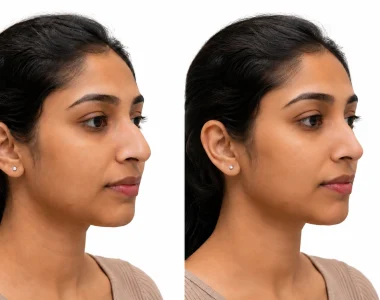
Combined Structure and Breathing Concerns
Reconstructive Rhinoplasty for Combined Structural and Functional Loss
In some patients, structural damage affects appearance and breathing at the same time — a collapsed valve that also shows externally, or a septum so displaced it distorts the visible bridge. Reconstruction plans for these cases the way septorhinoplasty or functional rhinoplasty would, but with the added step of rebuilding support that neither procedure typically has to address from scratch.
- Structural damage affecting both shape and airflow
- Obstruction linked directly to visible external distortion
- Need for reconstruction before either concern can be addressed
- Willingness to plan around a longer, more involved recovery
Reconstructive Situations
Reconstructive Rhinoplasty Situation Comparison
The cause and extent of structural loss shapes both the surgical approach and the recovery involved. The exact plan is personalised after examination.
| Situation | Focus | Common Goal | Recovery |
|---|---|---|---|
| Post-Traumatic Deformity | Structural realignment | Correct displacement and restore airflow | Longer recovery than routine reshaping; support settles over months |
| Congenital Nasal Difference | Individualised structural planning | Improve symmetry, proportion and breathing together | Recovery depends on the extent of structural change made |
| Loss of Support After Prior Surgery | Reconstruction and grafting | Rebuild support lost during earlier surgery | Extended recovery, reflecting scarred and altered tissue |
| Tissue Loss or Disease-Related Damage | Grafting and staged reconstruction | Restore missing structure over one or more operations | Can span several months to over a year across stages |
| Combined Structure and Breathing Concerns | Structure, airway and appearance together | Coordinate rebuilding, breathing and shape in one plan | Reflects the full combined scope of correction |
Timing and Suitability
When Is Reconstructive Rhinoplasty Considered?
Reconstructive rhinoplasty is considered whenever the underlying nasal framework — rather than just its surface appearance — needs to be rebuilt, repositioned or reinforced. This is different from wanting a nose reshaped for purely aesthetic reasons, and the distinction matters because it changes what the surgery actually needs to achieve first.
A confirmed structural problem, not just a cosmetic preference
Before reconstruction is recommended, examination should confirm that cartilage, bone or soft tissue is genuinely missing, displaced or too weak to support the desired result — rather than the concern being one that standard reshaping could address on its own.
Healing and staging matter
Where damage is extensive, attempting everything in one operation isn't always realistic. Swelling, scar maturation and how well a graft integrates can all influence whether a second procedure is planned from the outset rather than treated as a fallback.
Reconstructive rhinoplasty tends to come up in consultation for people dealing with:
- Structural damage or displacement following significant trauma
- Congenital differences affecting nasal shape or airway function
- Inadequate support remaining after one or more previous operations
- Tissue loss from infection, disease or its treatment
Emotional readiness matters here as much as the physical assessment. The best candidates understand that reconstruction aims for a stable, functional result appropriate to their anatomy — not a guaranteed return to how the nose looked before any damage occurred.
Finding the Right Starting Point
Explore Related Nasal Treatment Options
Not every nose that has been affected by trauma, disease or previous surgery needs full structural reconstruction. Depending on what examination finds, a more specific procedure may be the better fit.
- If a previous rhinoplasty left only contour irregularities without significant structural loss, revision rhinoplasty may be the more accurate description of what's needed.
- If breathing difficulty exists without meaningful external deformity, functional rhinoplasty addresses that on its own.
- If a deviated septum and external distortion occur together with no prior surgery involved, septorhinoplasty may cover the same ground with a smaller procedure.
- If your concern is broader ENT-related — sinus, allergy or general nasal health rather than structural rebuilding — the clinic's general ENT services may be the more relevant starting point.
Working out which of these actually fits your situation is exactly what a reconstructive consultation is for — arriving unsure which category applies is a completely normal starting point.
Potential Benefits
Potential Benefits of Reconstructive Rhinoplasty
01 A Genuinely Stable Foundation
Rebuilding what was lost or weakened gives the nose real structural support, rather than a shape held together by insufficient underlying tissue.
02 Protected or Restored Breathing
Addressing collapsed valves, displaced septal cartilage or narrowed passages can meaningfully improve airflow that structural damage had compromised.
03 More Balanced, Durable Appearance
Correcting the framework beneath the skin tends to produce results that hold their shape better over time than surface-level adjustment alone.
04 A Realistic Path for Complex Cases
Staging treatment where necessary means even significant structural loss can be addressed safely, rather than attempting too much in a single operation.
05 Function and Form Planned Together
Because the same structures affect both breathing and appearance, addressing them in one coordinated plan avoids treating either in isolation.
Safety & Recovery
Possible Risks of Reconstructive Rhinoplasty
Because reconstruction often involves grafting, staged procedures or operating on already-altered tissue, it carries a somewhat broader set of considerations than routine cosmetic reshaping.
Donor-Site Considerations
When ear or rib cartilage is used as graft material, the donor site itself requires healing and carries its own, generally minor, set of risks separate from the nose.
Graft-Related Complications
Grafts can occasionally shift, warp or partially resorb during healing, which is part of why graft behaviour is monitored closely during follow-up.
Prolonged or Staged Recovery
Complex reconstruction can require more than one operation, meaning the overall timeline to a final result is longer than for a single-stage procedure.
Residual Asymmetry or Contour Irregularity
Given the extent of tissue involved, some degree of residual irregularity can remain even after a technically successful reconstruction.
Bleeding, Infection or Further Surgery
As with any nasal operation, bleeding and infection are possible, and the complexity of reconstructive cases means further surgery is discussed as a realistic possibility, not a remote one.
The Surgical Journey
Reconstructive Rhinoplasty: Step-by-Step Procedure
The sequence below reflects a typical reconstructive pathway; the exact steps depend heavily on the cause and extent of the structural defect.
-
01
Map the Structural Defect
The cause of the deformity, previous injuries or operations, current obstruction, available records or photographs, and the patient's main functional and structural concerns are reviewed in detail.
A detailed consultation is an important first step in understanding the existing nasal structure, previous treatment and realistic surgical goals. Read our guide on rhinoplasty consultation to understand what is typically discussed, examined and planned before rhinoplasty surgery.
-
02
Examine Remaining Structure
The bony vault, septum, middle vault, sidewalls, tip, skin, scars and internal airway are assessed to establish exactly what remains and what needs to be rebuilt.
-
03
Plan Graft and Support Requirements
Where native cartilage is insufficient, septal, ear or rib cartilage may be planned as graft material, chosen according to the strength, shape and quantity the reconstruction requires.
-
04
Rebuild the Framework
Structural support is reestablished at the septum, bridge, sidewalls or tip before any visible contour refinement is attempted, protecting the airway throughout.
-
05
Refine Contour Within Available Tissue
Once support is stable, the visible bridge, tip and symmetry are refined within the limits set by the remaining tissue, scarring and graft material used.
-
06
Monitor Healing and Plan Further Stages
Swelling, scar maturation and graft integration are monitored over time, and any further staged procedure is planned once the current result has fully settled.
Before Surgery
How to Prepare for Reconstructive Rhinoplasty
Preparation for reconstructive surgery starts with establishing exactly what happened to the nose — an injury, a previous operation, a disease process, or a difference present from birth — alongside a detailed medical assessment. Investigations are selected according to the likely scope of reconstruction and planned anaesthesia.
Where relevant, bringing prior imaging, operative notes or photographs meaningfully sharpens planning, since it clarifies what was already changed rather than leaving the surgeon to estimate from examination alone.
Commonly Considered Pre-Surgical Preparation
- Complete Blood Count (CBC): may identify anaemia, infection or other blood-related concerns.
- Coagulation Profile: helps assess blood-clotting function when indicated.
- Electrocardiogram (ECG): may be advised when age, medical history or anaesthesia assessment makes it appropriate.
- Imaging such as CT or X-ray: helps clarify remaining bone and cartilage structure, particularly after trauma or prior surgery.
- Allergy and medication review: helps identify relevant reactions, current medicines and anaesthetic considerations.
- Nasal endoscopy: may be used to directly assess the septum and internal airway.
- Liver and kidney function testing: may be advised when medical history or medication planning makes these checks relevant.
Patients should provide a complete and accurate medical history, including previous operations, regular medicines, allergies and any conditions that may influence anaesthesia or healing.
When Surgery May Need to Wait
When Reconstructive Rhinoplasty May Need to Wait
Elective reconstruction may be delayed or reconsidered when healing from a recent injury or previous operation is incomplete, an active infection is present, or the current tissue state makes the outcome difficult to judge fairly.
- Recent trauma where swelling and tissue changes haven't yet fully settled
- An active nasal or sinus infection requiring treatment before elective surgery
- Ongoing disease processes that haven't yet stabilised
- Uncontrolled diabetes, significant bleeding disorders or other uncontrolled medical conditions
- Pregnancy or breastfeeding, when elective surgery is generally deferred
- Untreated severe psychological concerns that may affect the decision or expected satisfaction
- Expectations of an exact restoration that the remaining tissue cannot realistically support
Suitability is ultimately decided after an individual medical and surgical assessment. Clear communication with the surgeon about what reconstruction can and cannot achieve is essential before proceeding.
Reconstructive Rhinoplasty Safety
Understanding the Safety of Reconstructive Rhinoplasty
Reconstructive rhinoplasty is generally considered safe when the patient is thoroughly assessed and surgery is carried out by a surgeon experienced with complex structural cases.
Surgeon's Expertise
Experience specifically with grafting and structural reconstruction matters more here than in standard reshaping, since the anatomy involved is often incomplete or already altered.
Facility Standards
A properly equipped surgical facility with trained staff and emergency protocols is especially important for longer, more complex reconstructive procedures.
Pre-Surgical Assessment
Medical history, examination and any necessary investigations help identify conditions that could increase anaesthetic or surgical risk.
Anaesthesia Safety
When anaesthesia is administered and monitored by qualified professionals, modern techniques provide controlled, closely monitored care for longer reconstructive procedures.
Treatment Planning
Cost of Reconstructive Rhinoplasty in India
Reconstructive rhinoplasty is priced according to the extent of structural rebuilding required, which varies far more than for standard cosmetic reshaping. A minor graft to reinforce a single weak area costs considerably less than a staged reconstruction spanning multiple operations.
Because every reconstructive case depends on what actually needs rebuilding, an individual quote is the only meaningful estimate. If assessment shows the concern is more limited than expected — say, contour irregularity without real structural loss — a narrower option such as revision rhinoplasty may turn out to be sufficient, which would also reduce the overall cost.
What Can Reconstructive Rhinoplasty Cost Include?
- Surgeon's fee: reflects the complexity of structural rebuilding and graft planning involved.
- Facility charges: covers the operating theatre, nursing support, equipment and hospital services, scaled to procedure length.
- Anaesthesia: priced according to the anaesthetic approach and total procedure time.
- Pre- and post-operative care: includes investigations, medicines, dressings and the extended follow-up complex cases usually require.
Ask specifically what is included in the quoted fee, and whether staged procedures, if needed, are priced separately or as part of an overall plan.
Important Notes Before Deciding
- Confirm exactly which services and follow-up appointments are included in the quoted price.
- Ask whether a second procedure, if likely, is already factored into the estimate.
- Prioritise experience with reconstructive and graft techniques over the lowest quoted price.
- For international patients, factor in travel costs, exchange rates and any applicable taxes.
India offers access to experienced surgical teams and established hospital facilities, but the right choice should always rest on the individual clinical assessment rather than cost alone.
Reconstructive Rhinoplasty FAQs
Frequently Asked Questions About Reconstructive Rhinoplasty
General information about nasal reconstruction, grafts, trauma, congenital concerns, breathing and staged treatment.
Ask About Reconstructive RhinoplastyWhat is reconstructive rhinoplasty?
Reconstructive rhinoplasty restores or rebuilds abnormal, damaged or deficient nasal structures. It may aim to improve support, contour, symmetry, breathing, or a combination of these, depending on the underlying cause.
How is reconstructive rhinoplasty different from cosmetic rhinoplasty?
Cosmetic rhinoplasty primarily changes visible nasal appearance using intact underlying structure. Reconstructive rhinoplasty focuses on restoring structures affected by trauma, congenital differences, tissue loss, disease or previous surgery, although appearance and function often overlap in these cases.
Can reconstructive rhinoplasty improve breathing?
It may, when obstruction is related to a deviated or damaged septum, collapsed or narrowed nasal valves, weakened sidewalls, or other structural abnormalities. Improvement depends on accurately identifying the source of obstruction rather than changing external shape alone, and cannot be guaranteed in every patient.
Will cartilage grafting be required?
Not in every case. Grafting is considered when existing cartilage cannot provide sufficient support, length or valve stability. Septal cartilage is typically preferred when available; ear or rib cartilage may be used when a different shape, flexibility or greater strength is needed.
Can reconstructive rhinoplasty require more than one operation?
Yes. Complex defects, significant tissue loss or staged reconstruction plans may need more than one procedure. The likely sequence and timing between stages should be discussed during initial planning.
Can the nose be restored exactly to how it looked before?
Exact restoration cannot be guaranteed. The achievable result depends on the extent of the defect, available tissue, scarring, remaining support and individual healing.
How long does recovery from reconstructive rhinoplasty take?
Initial bruising and prominent swelling usually improve within the first few weeks, but the nose continues to change as deeper swelling resolves and scar tissue matures. Final contour assessment can take many months, and staged reconstruction extends the overall treatment timeline further.
Take the Next Step
Discuss Reconstructive Rhinoplasty With Dr. Manali Kakadia
Book a consultation to review nasal deformity, structural loss, airway function and reconstructive treatment options tailored to your individual anatomy.