
rhinoplasty Surgeon
Septorhinoplasty
A deviated septum on its own is treated with septoplasty. A crooked external nose on its own is treated with rhinoplasty. Septorhinoplasty exists for a narrower group of patients — those whose septal deviation and external distortion sit on the same side and are genuinely connected, so that straightening the septum alone would not relieve the obstruction because the outer nasal skeleton is itself part of the blockage. Dr. Manali Kakadia examines both structures together before recommending the combined procedure, rather than treating it as the default option for anyone with a crooked nose.
Patients considering septorhinoplasty can benefit from an assessment by an experienced ENT surgeon in Rajkot who can evaluate both nasal function and external structure before recommending the appropriate surgical approach.
- Obstruction traced to both the septum and the external skeleton, on the same side
- Combined surgery recommended only when it is genuinely required, not by default
- Recovery timeline and realistic breathing outcome explained in specific, honest terms
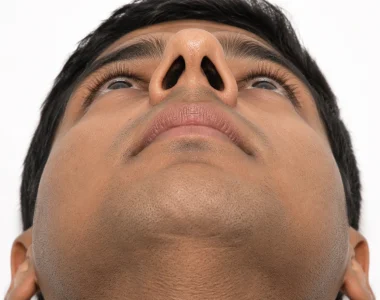
Combined Nasal Surgery Explained
How Septorhinoplasty Differs From Septoplasty or Rhinoplasty Alone
Surgeons typically reserve septorhinoplasty for a specific pattern: nasal obstruction on the same side as the septal deviation, where the external nasal skeleton is contributing enough to the blockage that septoplasty by itself would not fully resolve it. If the outer nose looks reasonably straight and only the septum is bent, septoplasty alone is usually sufficient. If breathing is unaffected and only the external shape is a concern, rhinoplasty alone is usually sufficient. Septorhinoplasty sits in the overlap between these two situations, within the broader field of rhinoplasty treatment .
This distinction matters because it is easy to assume that any combination of a crooked nose and blocked breathing automatically calls for combined surgery. Clinical criteria used internationally define the indication more narrowly. NHS England's published commissioning policy for ENT procedures sets out that combined septal and external correction is appropriate specifically where there is significant obstruction on the same side as the deviation, and where the external skeleton itself needs correcting for the airway to genuinely improve — not for appearance alone. The same clinical logic guides how septorhinoplasty is assessed here, even though this is a privately planned procedure rather than an NHS-funded one.
The first goal of consultation, then, is establishing whether a patient genuinely fits this pattern — not assuming that visible crookedness explains a breathing problem, or that a breathing problem explains visible crookedness, without confirming the link on examination.
Treatment Information
Septorhinoplasty Treatment Details
| Condition / Concern | Septal deviation with obstruction linked to external skeletal distortion |
|---|---|
| Procedure | Septorhinoplasty |
| Typical Procedure Time | Approximately 2 to 3 hours under general anaesthetic |
| Performed By | Qualified ENT and rhinoplasty surgeon |
Understanding Septorhinoplasty
What Is Septorhinoplasty
The procedure has two parts, carried out in the same operation. First, the septum — the wall of cartilage and bone dividing the two nostrils — is accessed from inside the nose and straightened, usually by trimming or repositioning the deviated section. Second, the external nasal bones are surgically repositioned; where the framework has been fractured or displaced, this can involve carefully breaking and resetting the bone to correct alignment.
Correcting the internal structure before addressing the external one reflects how physically connected the two are: the cartilage and bone that support the septum also help hold the bridge in position. The American Academy of Otolaryngology–Head and Neck Surgery's patient resource on deviated septum explains how a longstanding septal deviation can itself contribute to visible external irregularity over time, which is part of why the two structures are examined together rather than separately. Patients whose problem is confined to the septum, without a meaningful external component, can read more about deviated septum treatment on its own.
Septorhinoplasty is most often discussed after a fracture that has displaced the internal and external structures together, or in longstanding asymmetry where the two have never previously been assessed as connected.
For a more detailed guide to septorhinoplasty, including who may need the combined procedure, how surgery is performed, recovery, possible risks, cost and what to expect during treatment, read our article on septorhinoplasty in Rajkot .
Explore Common Scenarios
Septorhinoplasty: Which Situation Best Describes You?
A handful of patterns account for most septorhinoplasty consultations. See which one is closest to your own situation.
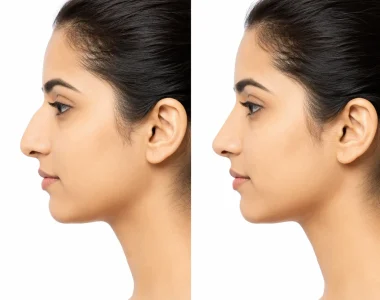
Post-Traumatic Crooked Nose
Septorhinoplasty After Nasal Trauma
An impact or fracture rarely stays contained to one structure — it can knock the septum off-centre internally while bending the visible bridge at the same time, which is why the two so often present together after an injury. If the obstruction turns out to be the dominant issue on examination, a more limited septoplasty surgery may be enough on its own.
- History of a broken nose or significant impact injury
- Visible bend that appeared after the injury, not before it
- Breathing that clearly worsened following the trauma
- Both internal and external deviation confirmed on the same side
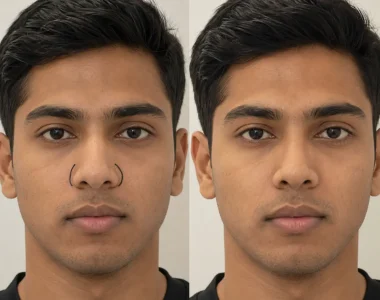
Congenital Nasal Asymmetry
Septorhinoplasty for Naturally Asymmetric Noses
Not every crooked nose follows an injury. In some patients, the septum and the external framework grow slightly out of alignment together as the face matures, with no trauma to point to. Because this pattern has usually been present for years without being formally diagnosed, both the internal and external components typically need their own dedicated examination rather than one being assumed to explain the other.
- Asymmetry present since childhood or adolescence, with no clear cause
- No history of nasal injury or fracture
- Breathing difficulty consistently worse on the narrower side
- External and internal deviation confirmed together on examination

Revision After Previous Surgery
Septorhinoplasty as a Revision Procedure
When breathing or shape concerns persist — or return — after an earlier nasal operation, the cartilage and bone underneath may have shifted, scarred or weakened in ways that a single-focus re-operation would not fully account for. A closer look at revision rhinoplasty can help establish whether it is the septum, the external framework, or genuinely both that need to be revisited.
- One or more previous nasal or septal operations
- Breathing or shape concerns that never fully resolved
- New irregularity that appeared after earlier treatment
- Structural support weakened by prior surgery
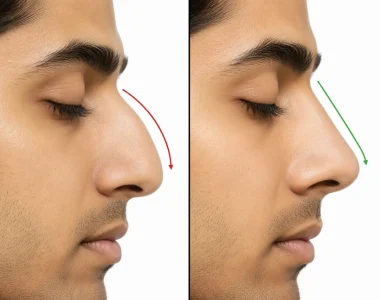
Combined Bridge and Septal Deviation
Septorhinoplasty for Severe Bridge and Septal Deviation
When the bridge visibly leans to one side and the septum is significantly deviated on the same side, correcting the bridge without addressing the septum can leave the internal support unstable, while correcting the septum without addressing the bridge will not straighten the nose the patient sees in the mirror. Neither half of the problem resolves the other.
- Bridge that visibly leans or curves to one side
- Significant septal deviation confirmed on examination
- Breathing consistently worse on the same side as the lean
- Structural support required alongside realignment
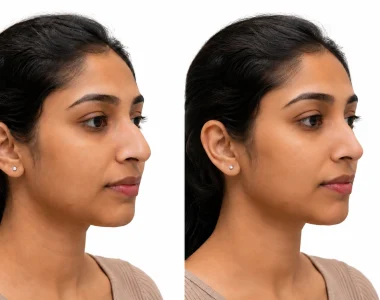
Combined Cosmetic and Functional Goals
Septorhinoplasty for Combined Breathing and Appearance Goals
Some patients arrive at consultation wanting both — easier breathing and a more balanced appearance — and are weighing functional rhinoplasty against cosmetic rhinoplasty as separate options. When the two concerns are genuinely linked to the same underlying deviation, addressing them together tends to give a more complete and durable result than choosing one and revisiting the other later.
- Both breathing and appearance concerns present at the same time
- Preference for one recovery rather than two separate procedures
- A single structural cause identified behind both concerns
- Willingness to plan a longer, more involved single surgery
Septorhinoplasty Scenarios
Septorhinoplasty Scenario Comparison
The scenarios above involve different combinations of internal and external correction. The table below summarises how the focus and recovery differ.
| Scenario | Focus | Common Goal | Recovery |
|---|---|---|---|
| Post-Traumatic Crooked Nose | Internal and external realignment | Correct displacement caused by injury | Splint removed at around one week; breathing continues to settle for up to three months |
| Congenital Nasal Asymmetry | Long-standing structural imbalance | Improve symmetry and airflow together | Early swelling eases within two to three weeks; contour refines over several months |
| Revision After Previous Surgery | Reassessment of prior correction | Address remaining or returned concerns | Often slower, due to scarred or previously altered tissue |
| Combined Bridge and Septal Deviation | Structural support and alignment | Straighten the bridge while stabilising the septum | Early swelling settles first; structural refinement continues for months |
| Combined Cosmetic and Functional Goals | Breathing and appearance together | Address both concerns in one coordinated plan | Reflects the combined scope of correction being undertaken |
Septorhinoplasty Suitability
Is Septorhinoplasty Right for You?
Clinical guidance in several countries reserves combined septal and external correction for a specific pattern: nasal obstruction on the same side as the deviation, present for most of the day, that has not responded to at least a few months of medical treatment such as nasal steroid sprays, together with a genuine external deformity that septoplasty on its own would not resolve. This benchmark is useful even outside a public healthcare system, because it separates patients who truly need the combined procedure from those who would do just as well with a simpler one.
Ruling out other causes first
Before combined surgery is recommended, it is worth checking for explanations that mimic structural obstruction but are managed medically rather than surgically — allergic rhinitis, chronic sinus inflammation, or overuse of over-the-counter decongestant sprays can all cause persistent blockage that has nothing to do with the shape of the septum or the external nose.
Overall health matters
Conditions that may affect anaesthesia, bleeding or wound healing should be reviewed before surgery is planned. Smoking slows healing and raises the risk of complications, so patients are generally advised to stop well before and after the operation.
Septorhinoplasty tends to come up in consultation for people concerned about:
- A crooked or asymmetric nose paired with obstruction on the same side
- Structural changes following nasal trauma or an earlier operation
- Long-standing asymmetry that affects both shape and breathing
- Wanting to address appearance and airflow in a single surgery
If only one half of this picture is present — obstruction without a meaningful external deformity, or external asymmetry without breathing difficulty — a single-focus procedure is usually the more appropriate, lower-risk option.
Emotional readiness matters just as much as the physical picture. The best candidates understand that surgery aims to meaningfully improve both function and appearance, not guarantee perfection in either.
Septorhinoplasty Expectations
Why Expectations Matter in Septorhinoplasty
Because two outcomes are being managed at once, it helps to separate "breathing" and "appearance" into two distinct conversations during consultation, rather than folding them into one vague idea of improvement.
- Breathing typically settles on a slower timeline than external swelling — congestion in the first weeks after surgery does not mean the correction has failed.
- The external result and the functional result can each take several months to fully reveal themselves, and rarely on exactly the same schedule.
- Contributing factors outside the operation, such as allergies or long-term spray use, should be discussed so they can be managed alongside surgery rather than mistaken for a surgical shortfall.
Setting these expectations early helps patients interpret their own recovery accurately, rather than judging the result too soon or against the wrong milestone.
Potential Benefits
Benefits of Septorhinoplasty
01 A Single Recovery Period
Correcting the septum and the external framework in one operation avoids repeating the anaesthesia, downtime and cost of two separate procedures months apart.
02 Airflow Improvement Where It's Actually Blocked
Addressing both the septum and the external skeleton means the airway is corrected at every point it is genuinely narrowed, not just the internal portion.
03 A More Balanced External Result
Realigning the framework connected to the septal deviation can reduce visible crookedness that a septum-only procedure would leave untouched.
04 Stronger Long-Term Structural Support
Reinforcing weakened cartilage while both structures are already being addressed lowers the likelihood of the nose gradually drifting out of position again.
05 One Considered Surgical Plan, Not a Guess
Assessing both concerns together at the outset avoids discovering, only after a more limited procedure, that a connected problem was never addressed.
Safety & Recovery
Possible Side Effects of Septorhinoplasty
Septorhinoplasty is generally considered a safe procedure, but combining internal and external correction means more anatomy is altered in a single operation than in either procedure alone. Patient information published by Cambridge University Hospitals NHS Foundation Trust gives a useful, specific picture of how often complications actually occur, which is summarised below alongside the wider range of possible side effects.
Bleeding
Reported at around one in a hundred patients in published UK hospital recovery data. If it occurs, it is usually managed with nasal packing; watery, blood-tinged discharge for the first couple of weeks is separate and normal.
Infection
Cited at roughly four in a hundred patients in the same UK hospital data. Increasing blockage, worsening pain, or a green and smelly discharge are the signs to report promptly rather than wait out.
Temporary Numbness
Numbness of the nasal tip, and occasionally the upper front teeth, is a recognised but uncommon after-effect. It generally settles by itself as the nerves recover.
Residual Asymmetry or Deviation
Cartilage can shift slightly during healing, so a degree of residual deviation or contour irregularity can remain even after a technically successful procedure.
Prolonged Nasal Blockage While Healing
A blocked feeling for the first few weeks is expected, not a complication — internal swelling needs time to subside, and breathing can take up to three months to feel fully clear again.
The Surgical Journey
Septorhinoplasty: Step-by-Step Procedure
The sequence below is typical of how septorhinoplasty is carried out; the exact steps depend on which internal and external concerns are being addressed together.
-
01
Septorhinoplasty Consultation
Breathing history, prior injury or surgery and cosmetic goals are reviewed, and the internal airway and external framework are examined together to confirm the combined procedure is genuinely needed.
-
02
General Anaesthesia
The operation is performed under general anaesthesia, meaning the patient is fully asleep throughout the two to three hours it typically takes.
-
03
Septum Corrected First
An incision is made inside the nose, and the deviated portion of the septum is straightened, usually by removing a small amount of the bent cartilage or bone.
-
04
External Bones Repositioned
The nasal bones are then carefully broken and reset to correct the external alignment. Dissolvable stitches hold the corrected structures in place internally.
-
05
Packing and Splinting
Because most of the procedure is performed from inside the nose, external scarring is usually limited to a couple of small marks. Nasal packing is often placed in both nostrils and typically removed the following morning; an external splint stays on for about a week, and small internal splints are sometimes used for a further one to two weeks to discourage scar tissue.
-
06
Recovery and Follow-Up
A follow-up appointment around one week after surgery is used to remove the external splint. Breathing and external healing are then tracked separately over the following months.
Before Surgery
How to Prepare for Septorhinoplasty
Preparation begins with a detailed consultation and medical assessment. Investigations are selected according to medical history, planned anaesthesia and the combined scope of internal and external correction being considered.
If decongestant nasal sprays have been used regularly for an extended period, stopping them before assessment is often necessary — overuse of these sprays can itself cause congestion that mimics structural obstruction and can distort the picture on examination. Previous nasal injury, earlier surgery and relevant medical history should also be discussed in detail. Patients whose structure was significantly weakened by an earlier injury or operation may need a more extensive reconstructive rhinoplasty assessment alongside standard septorhinoplasty planning.
Commonly Considered Pre-Surgical Preparation
- Complete Blood Count (CBC): may identify anaemia, infection or other blood-related concerns.
- Coagulation Profile: helps assess blood-clotting function when indicated.
- Electrocardiogram (ECG): may be advised when age, medical history or anaesthesia assessment makes it appropriate.
- Imaging such as CT or X-ray: can provide additional information about internal nasal and structural anatomy when clinically necessary.
- Allergy and medication review: helps identify relevant reactions, current medicines and anaesthetic considerations.
- Nasal endoscopy: may be used to directly visualise the septum and internal airway before planning treatment.
- Liver and kidney function testing: may be advised when medical history or medication planning makes these checks relevant.
Patients should provide a complete and accurate medical history, including previous operations, regular medicines, allergies and any conditions that may influence anaesthesia or healing.
When Surgery May Be Delayed or Unsuitable
When Septorhinoplasty May Need to Be Delayed
Elective septorhinoplasty may be delayed or reconsidered when an existing medical condition, active infection, smoking status or unrealistic expectations could make combined surgery unsafe or make the outcome difficult to judge fairly.
- Obstruction that turns out to be explained by allergic rhinitis, sinus infection or spray overuse rather than a fixed structural problem
- Patients whose nasal and facial development is not yet sufficiently mature for elective combined surgery
- People with uncontrolled diabetes, significant bleeding disorders or other uncontrolled medical conditions that increase surgical risk
- Patients who are pregnant or breastfeeding, when elective surgery should generally be deferred
- Individuals with untreated severe psychological concerns or body dysmorphic disorder that may affect the decision or expected satisfaction
- Patients with an active nasal or sinus infection requiring treatment before elective surgery
- Heavy smokers who are unwilling or unable to follow the surgeon's instructions about stopping smoking around surgery
Previous nasal surgery can change the underlying cartilage, bone and soft-tissue structure significantly. Where damage is extensive, a more detailed reconstructive rhinoplasty assessment may be needed before combined correction is considered.
Suitability is ultimately decided after an individual medical and surgical assessment. Clear communication with the surgeon is essential before proceeding.
Septorhinoplasty Safety
Understanding the Safety of Septorhinoplasty
Septorhinoplasty is generally regarded as a safe procedure when patients are appropriately assessed beforehand and surgery is carried out by a qualified surgeon in a properly equipped facility.
Surgeon's Expertise
Experience with both internal septal correction and external nasal reshaping matters more here than in a single-focus procedure, since the two must be planned as one sequence.
Facility Standards
A suitable surgical facility with appropriate monitoring, trained staff and emergency protocols matters especially for a longer, combined procedure under general anaesthesia.
Pre-Surgical Assessment
Medical history, examination and any necessary investigations help identify conditions that could increase anaesthetic or surgical risk before the day of surgery.
Anaesthesia Safety
When anaesthesia is administered and monitored by qualified professionals, modern techniques provide controlled, closely monitored care for the full duration of the procedure.
Treatment Planning
Cost of Septorhinoplasty in India
Septorhinoplasty is typically priced above a standalone septoplasty or a purely cosmetic rhinoplasty, reflecting the longer operating time, greater surgical complexity and closer post-operative monitoring that combining both procedures involves. A precise figure can only be given after an individual consultation.
Because the procedure is planned around the individual, it is worth first confirming — through examination — whether both the septum and the external framework genuinely need correcting before comparing quotes. If it turns out that only breathing or only appearance is a significant concern, discussing functional rhinoplasty or cosmetic rhinoplasty on its own may be more appropriate, and will usually cost less.
What the Quoted Cost May Include
- Surgeon's fee: reflects qualifications, experience and the added complexity of combined correction.
- Facility charges: covers the operating theatre, nursing support, equipment and hospital services, scaled to the longer procedure time.
- Anaesthesia: priced according to the anaesthetic approach used and the total time under general anaesthesia.
- Pre- and post-operative care: includes investigations, medicines, dressings and the extended follow-up needed to monitor both breathing and appearance outcomes.
Ask specifically what is included in the quoted fee, and whether follow-up visits, medicines and other associated charges are billed separately.
Before You Compare Quotes
- Confirm exactly which services and follow-up appointments are included in the quoted price.
- Ask whether investigations, medicines, anaesthesia and facility charges are itemised separately.
- The septal, functional component may sometimes be eligible for insurance coverage even when the combined procedure is not; check this separately with your insurer.
- Prioritise experience with combined structural surgery over the lowest quoted price.
Septorhinoplasty consultations are available in Rajkot, with a rhinoplasty surgeon in Ahmedabad and a rhinoplasty surgeon in Kutch also available for patients outside Rajkot.
India offers access to experienced surgical teams and established hospital facilities, but the right choice should always rest on the individual clinical assessment and quality of care, not on cost alone.
Septorhinoplasty FAQs
Septorhinoplasty FAQs
Specific answers about how septorhinoplasty differs from a single-focus procedure, what to expect during surgery and how recovery actually unfolds.
Ask a QuestionWhat is septorhinoplasty?
Septorhinoplasty combines correction of the internal nasal septum with repositioning of the external nasal bones in a single operation, used when the two problems sit on the same side and are genuinely connected.
How is septorhinoplasty different from septoplasty or rhinoplasty alone?
Septoplasty addresses only the internal septum. Rhinoplasty addresses only the external nose. Septorhinoplasty is reserved for cases where obstruction and external deformity are linked closely enough that treating just one would leave the other unresolved.
How long does the procedure take and what happens during it?
It typically takes two to three hours under general anaesthetic. The septum is straightened first from inside the nose, then the external nasal bones are repositioned, with dissolvable stitches used internally and a splint worn externally for about a week.
How long before my breathing feels normal again?
Nasal packing, where used, is usually removed the morning after surgery, but internal swelling can leave the nose feeling blocked for several weeks. Published UK hospital guidance notes it may take up to three months for breathing to feel fully clear.
How much time should I take off work or activity?
A minimum of around two weeks off work is typical, alongside avoiding crowds and smoky environments while healing. Contact sports are usually avoided for about six weeks, and flying is generally avoided for around two weeks after surgery.
What are the risks of septorhinoplasty?
Published UK hospital data cites bleeding in around one in a hundred patients and infection in around four in a hundred. Other possible effects include temporary numbness, residual asymmetry and, rarely, the need for further revision.
How much does septorhinoplasty cost in India?
Cost depends on the extent of internal and external correction needed, surgical complexity, surgeon's fee, facility and anaesthesia charges and follow-up care. A personalised estimate can only be given after an individual assessment.
Take the Next Step
Plan Your Septorhinoplasty Consultation
Bring your breathing and appearance concerns to Dr. Manali Kakadia for an examination that checks whether they are genuinely connected, and what a combined septorhinoplasty approach would realistically involve for your anatomy.